Leadership Communication
I believe that the most important leadership skill that I have is communication. In Neal Gabler’s biography of Walt Disney, he described that Walt Disney held firm beliefs that nearly all workplace conflict can be prevented or managed by good communication. I tend to hold the same belief.
I present here my top 10 thoughts on the most important aspects of leadership communication:
#1 Transparent Communication: Transparent communication has been shown to grow trust and improve workplace engagement. Occasionally, folks will try to hoard knowledge or information - information is one of the six bases of power, as described by French and Raven. Transparent communication within an organization is contagious and folks who hoard information will be called out.
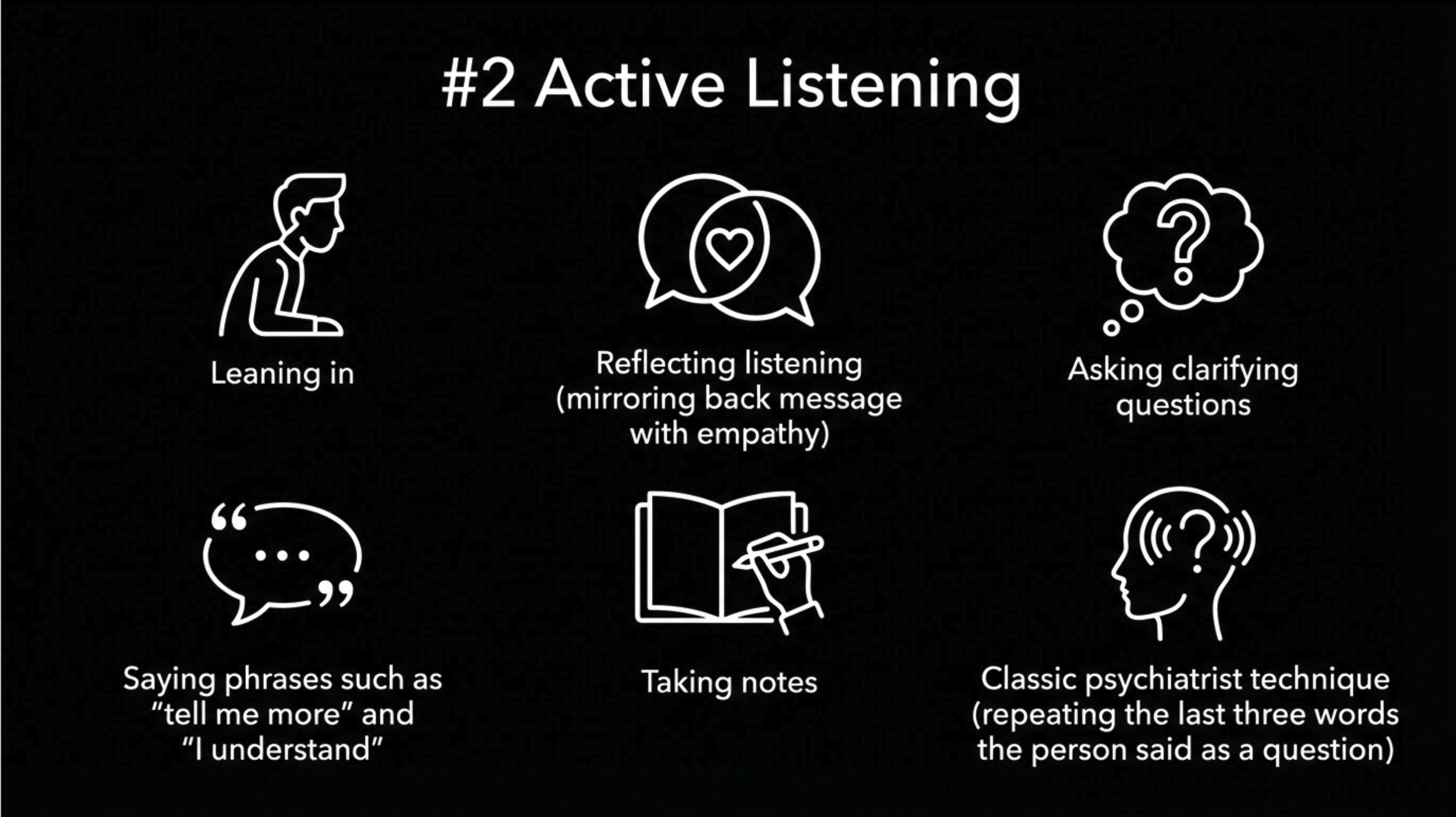
#2 Active Listening: Human beings want what they are saying to be heard by the other person. I am sure that this is probably some deep-rooted survival instinct related to that. Active listening can include the following: head nodding, leaning in, eye contact, paraphrasing, asking clarifying questions, and offering statements, such as “tell me more” or “I understand” while listening to the other person. Sending summaries after the conversation is also important for high stakes listening sessions. The classic psychiatrist technique is to repeat back the last three words the patient said as a question.
#3 Closed-Loop Communication: The number one cause of sentinel events in health care in America relates to communication issues. The tool that probably every medical school incorporates in education is closed-loop communication. It is the simple act of closing the loop with the other person. This goes hand in hand with active listening. Simple things like just acknowledging understanding is one way to close the loop. Responding to emails showing that you received and understood is a simple way to close the loop in the workplace on emails. Even a simple tap back on texts (e.g., thumbs up sign) can be an effective tool in closing the loop.
#4 Use Every Communication Tool: There have never been more communication tools like there are now. At OCOM, we use as many as we can: newsletters to employees and students, blog, podcasts, digital signage, social media, website, all-hands meetings (we call them State of OCOM meetings), department meetings, 1:1 meetings between supervisors and reports, special reports on high-priority
#5 Storytelling/Parabolic Storytelling: One of the oldest styles and arguably the most enduring is the act of storytelling. Parabolic Storytelling has been a powerful tool and the stories have endured for generations. People are more likely to remember more details in the context of a story than they can from a simple recall of facts. Moreover, the best educators typically use stories as an important tool in their teaching arsenal.
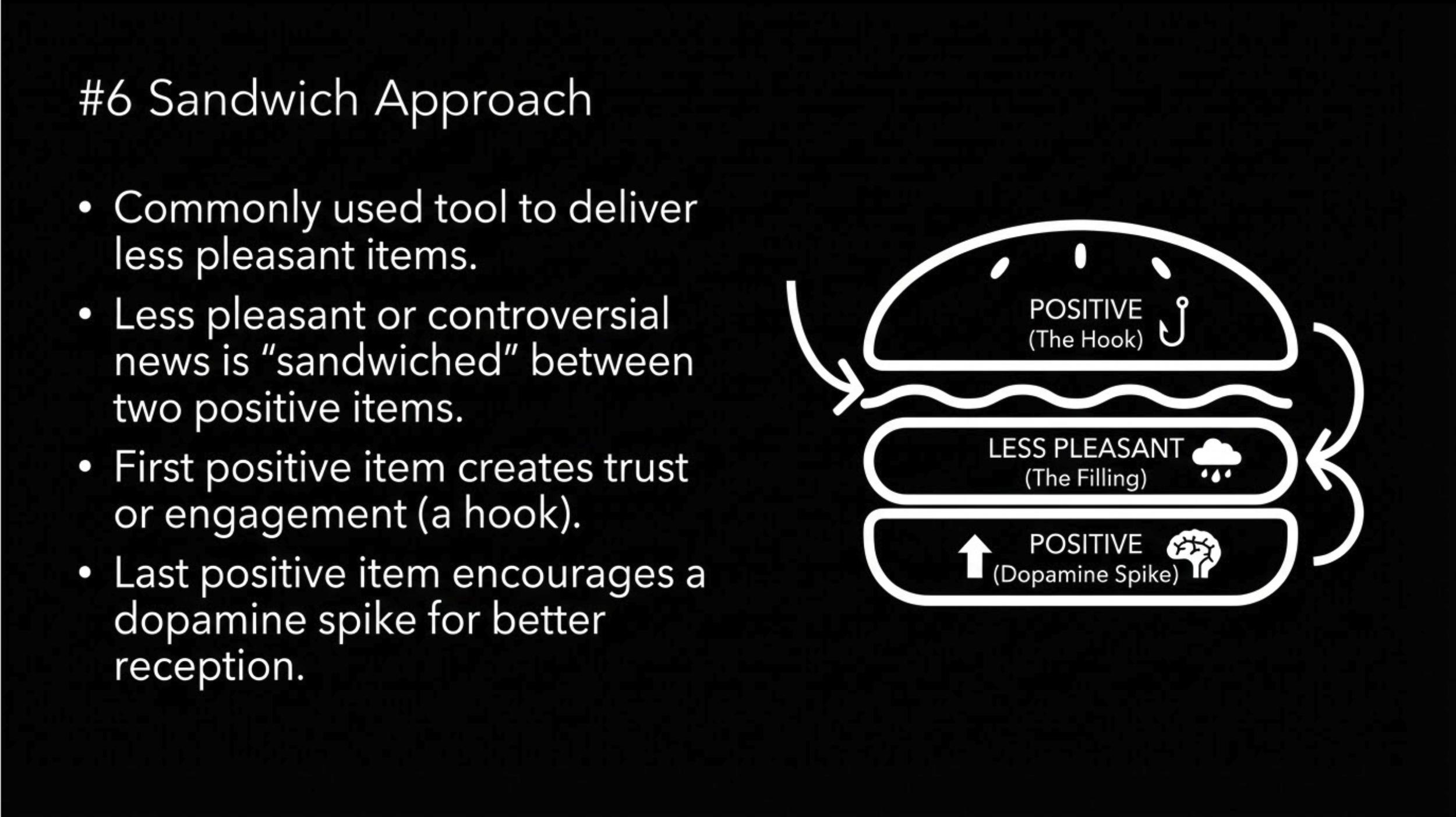
#6 Sandwich Approach: The sandwich approach is a commonly used tool where items that may be seen as less pleasant or controversial are sandwiched between two positive items in a conversation or a communication. The idea is that the first positive item will create a feeling of trust or engagement (a hook). The last positive news item will encourage another dopamine spike with the intention that the recipient will better receive the news items.
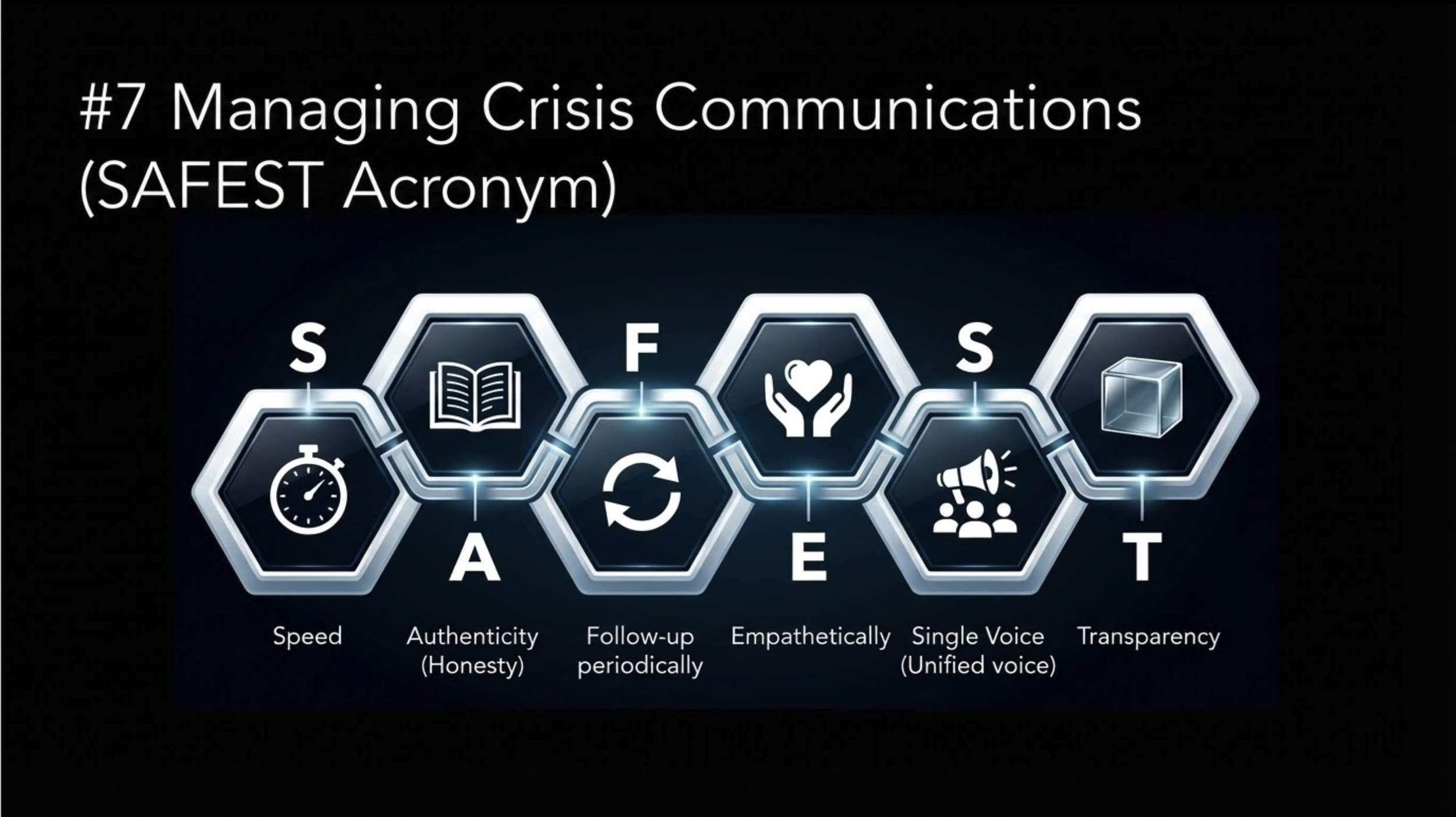
#7 Managing Crisis Communications: When crisis hits, leaders should speak with speed, transparency, honesty, empathetically, speak with a unified voice, and follow-up periodically. You can use the “SAFEST” acronym:
Speed
Authenticity (Honesty)
Follow-up periodically
Empathetically
Single Voice (Unified voice)
Transparency
#8 Empathetic Communications: Communicating empathetically can be one of the most challenging aspects of interpersonal communications for some people that don’t seem to have it naturally. Here are a few ways to do so: focus on who is speaking, focus on your non-verbal cues (e.g., flat voice and do a head tilt if they are giving you sad news), suspend judgement, use reflective sentences, and use empathetic phrases (e.g., “that sounds challenging”, “I could see how that is disappointing”, etc.). The various AI chats can rephrase written documents to make them sound more empathetic.
#9 Humor: Humor can be a classic defense mechanism in difficult situations, but it can also enhance feelings of trust and familiarity (after all, you probably use humor to communicate within your own family), when done properly (and in good/professional taste). Simple humor mechanisms such as the callback, incongruity, understatement, and self-deprecation and be safe in the workplace and potentially humorous. My co-workers are very forgiving to me when I tell my dad jokes and don’t always roll their eyes.
#10 What You Say is Important: Paying attention to the small things that you say are important. Some quick examples of this would be for leaders to say words like “because” - that word has been shown that the leader is more thoughtful. Also, using phrases such as, “does that sound reasonable”, are more likely to result in an affirmative action.
I hope that these considerations are helpful. The biggest piece of advice that I can share with any leader is to be intentional with your communications and to have a personal communications strategy - when you see a turtle on a lamp post, it didn’t get there by accident.